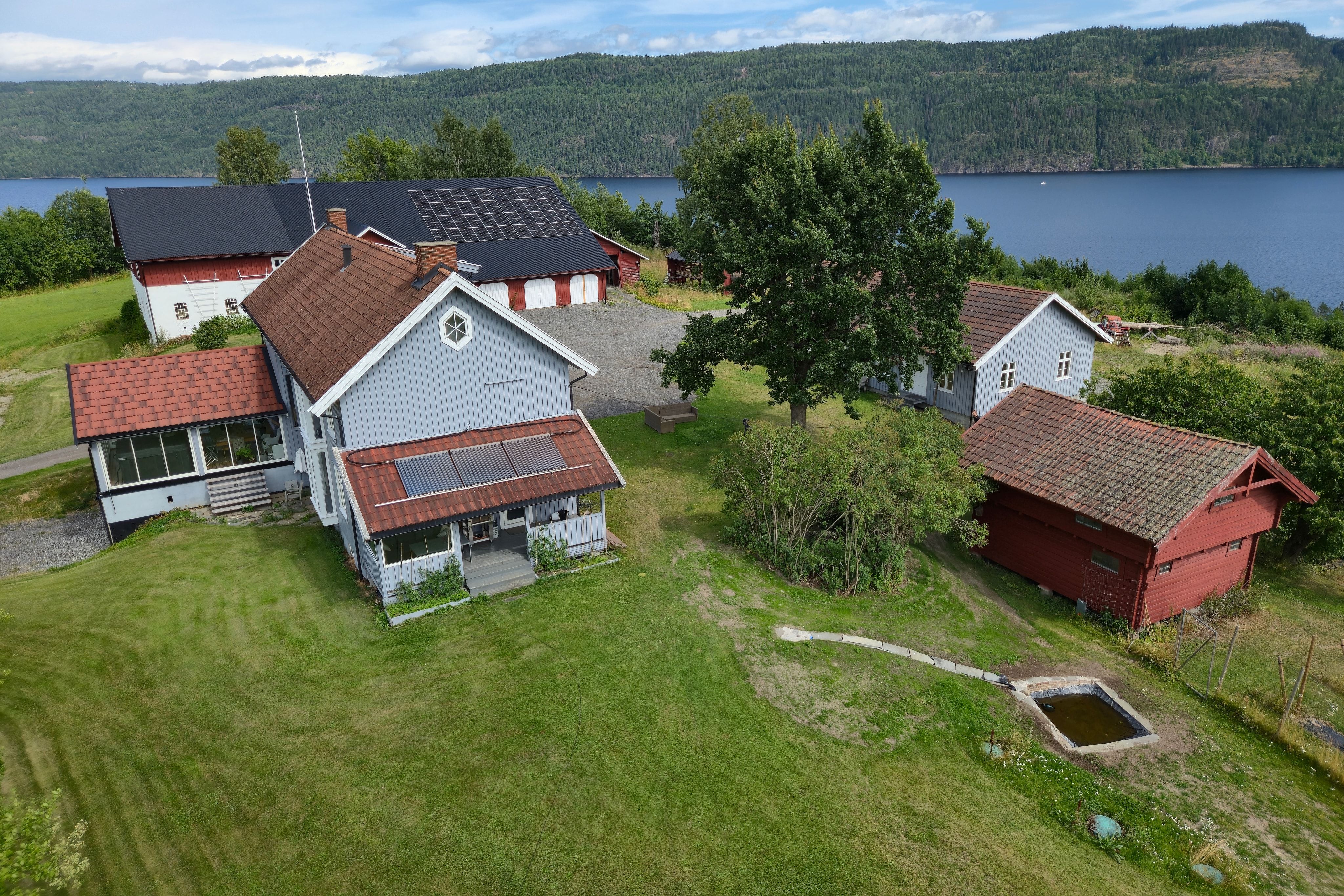
The farm
The farm sits at the top of Lier, looking out over Tyrifjorden. It has been worked, abandoned after the Black Death, and taken up again. The Bautz name arrived in 1919, the first vines in 2020.
Drag was cleared by the Viking age at the latest, and abandoned in the hard times after the Black Death.
The name most likely refers to the dråg between Nordre and Søndre Drag — a small valley with a stream running out into Holsfjorden. In Old Norse times there was probably a single farm here. From around 1600 there were two, and one of them, possibly Nordre Drag, had been taken up again shortly before.
- Viking age
Drag is cleared as a farm.
- 1300s
The farm is held in church ownership.
- After 1349
Drag lies abandoned.
- c. 1600
Farming is taken up again.
- 1752
The whole farmyard burns.
- 1753
A new main house is raised.
- 1855
Nordre Drag becomes a freehold farm.
- 1858
The main house is extended.
- 1897
The last known crofter’s holding is given up.
- c. 1960
Dairy production ends.
- 2010
Anne and André Bautz take over in July, from André’s father Terje and his wife Tori. The farm produces hay on a small scale, and plums.
- Today
A new chapter in the farm’s history begins, with winemaking.
The record up to 1960 is drawn from Lier municipality’s farm history for Drag and Nordre Drag. The dates from 2010 onwards are the family’s own.
Anne and André
André grew up partly in Nordland, in northern Norway, and spent the later part of his youth at Nordre Drag. Anne grew up on a vegetable and strawberry farm at Tranby, also in Lier. Both took technical degrees — André as a chartered engineer, Anne as an engineer — and worked for several years away from the farm before taking it on.
After some years with two small children, and then two teenagers, the family spent a period in Spain. When they returned to Øverskogen, André and their elder son Heine planted the first 500 vines. When their younger son Herman finished lower secondary school in Spain, the rest of the family followed, and growing grapes became a project shared by the adults, with a good deal of help from the young.
The wish to use the farm to grow something other than hay and plums had been there a long time. In 2020 they made good on it.
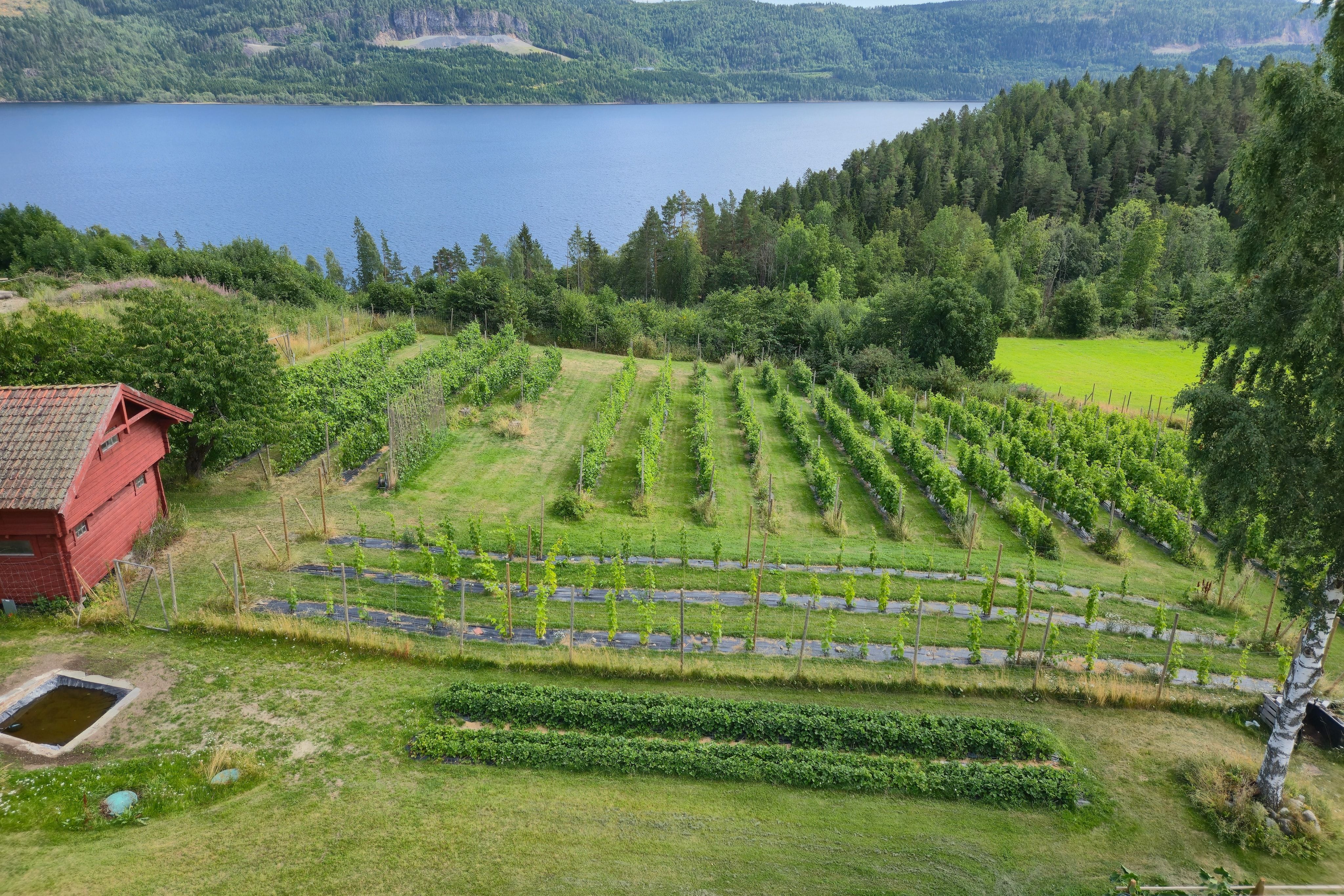
The vineyard in July.
The vineyard
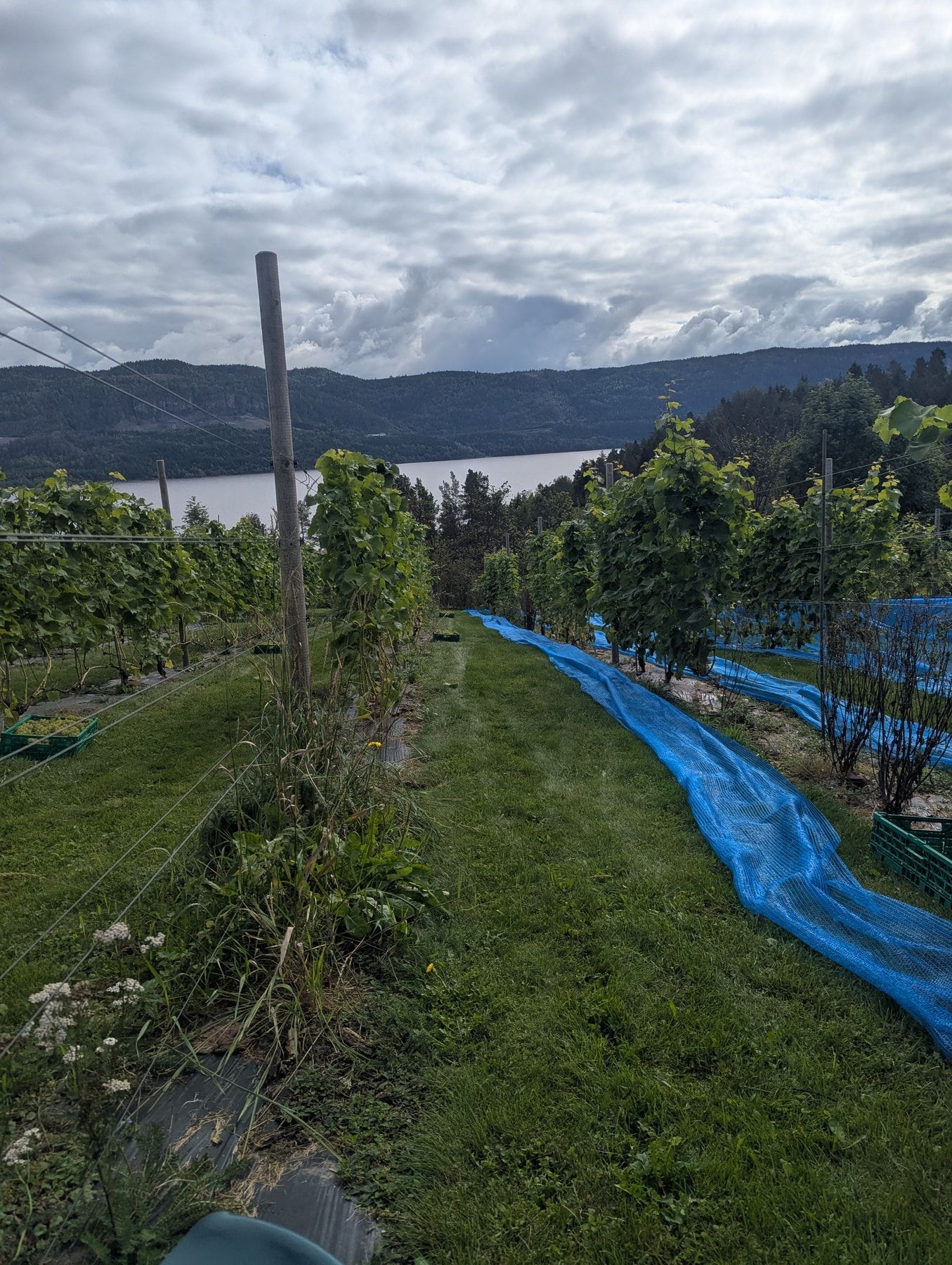
The rows fall towards the forest edge, with Tyrifjorden in front of them.
The first planting was made partly on newly broken land and partly where an organic kitchen garden had been. Some Rondo went in for red and rosé, and mostly Solaris for white.
Training
Every vine is rebuilt each year, from one chosen shoot.
The vines are trained on the Guyot system. A cane from the previous year is bent down, and carries up to seven shoots that bear fruit through the season. At the same time a single shoot is allowed up from the trunk. It grows through the year and carries the following season’s crop.
The method gives control over the crop. It also means a great deal of work by hand.
March and April
The season begins by cutting away the part of the vine that carried last year’s crop.
Bending down
This is where next year’s cane is chosen.
Spring to autumn
The shoots grow. They are tied in and trimmed continuously. This is the daily work among the vines, and it takes more time than anything else in the year.
Flowering
The flowers come, and they become bunches.
Tending the vines
Bunches thinned, growth kept in check, and tying in.
Ripening
Leaf stripping, netting so as not to share too much with thrushes and wasps.
Topping
When the shoots are around 150 centimetres tall they are topped, to encourage ripening.
September
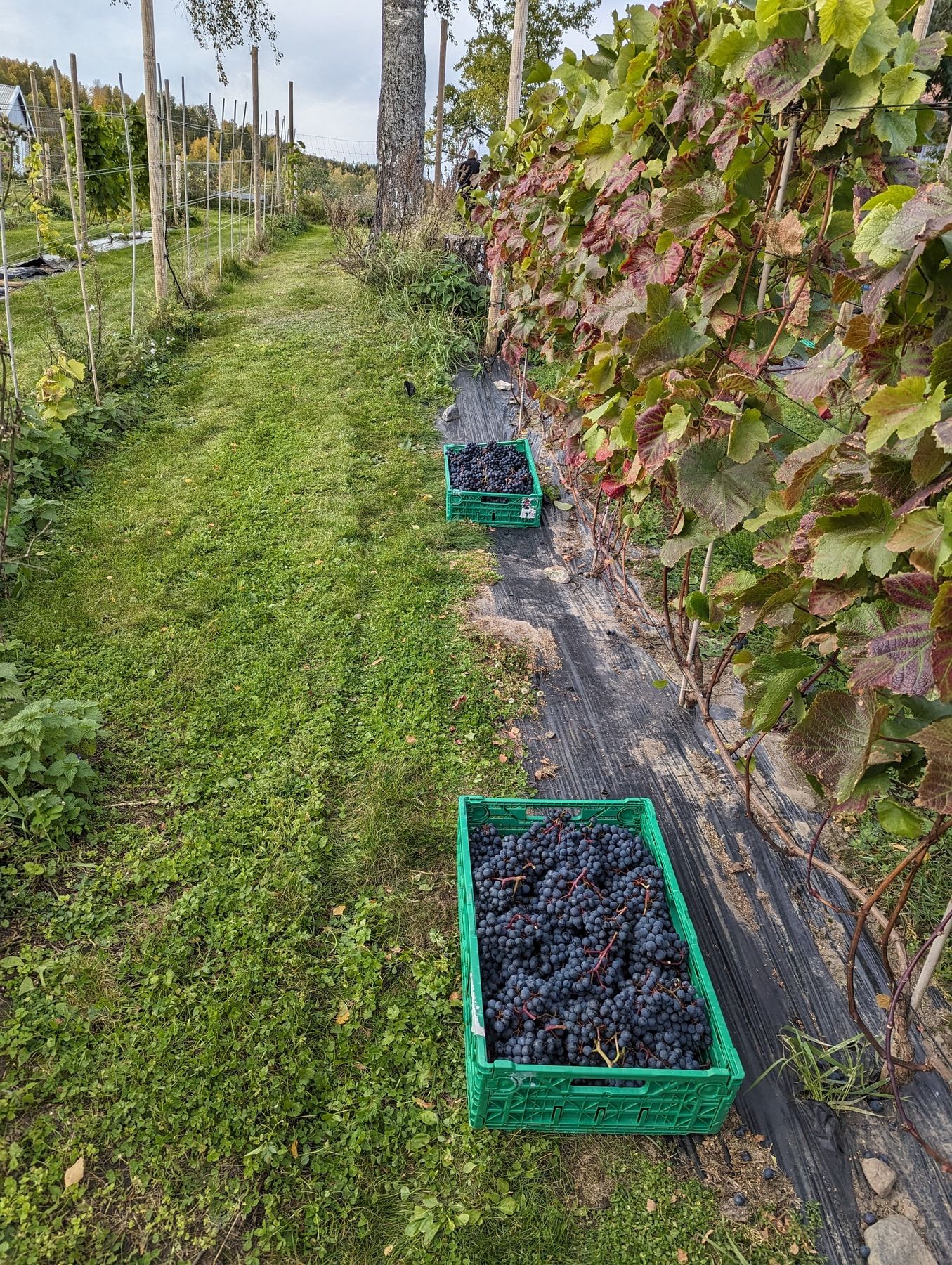
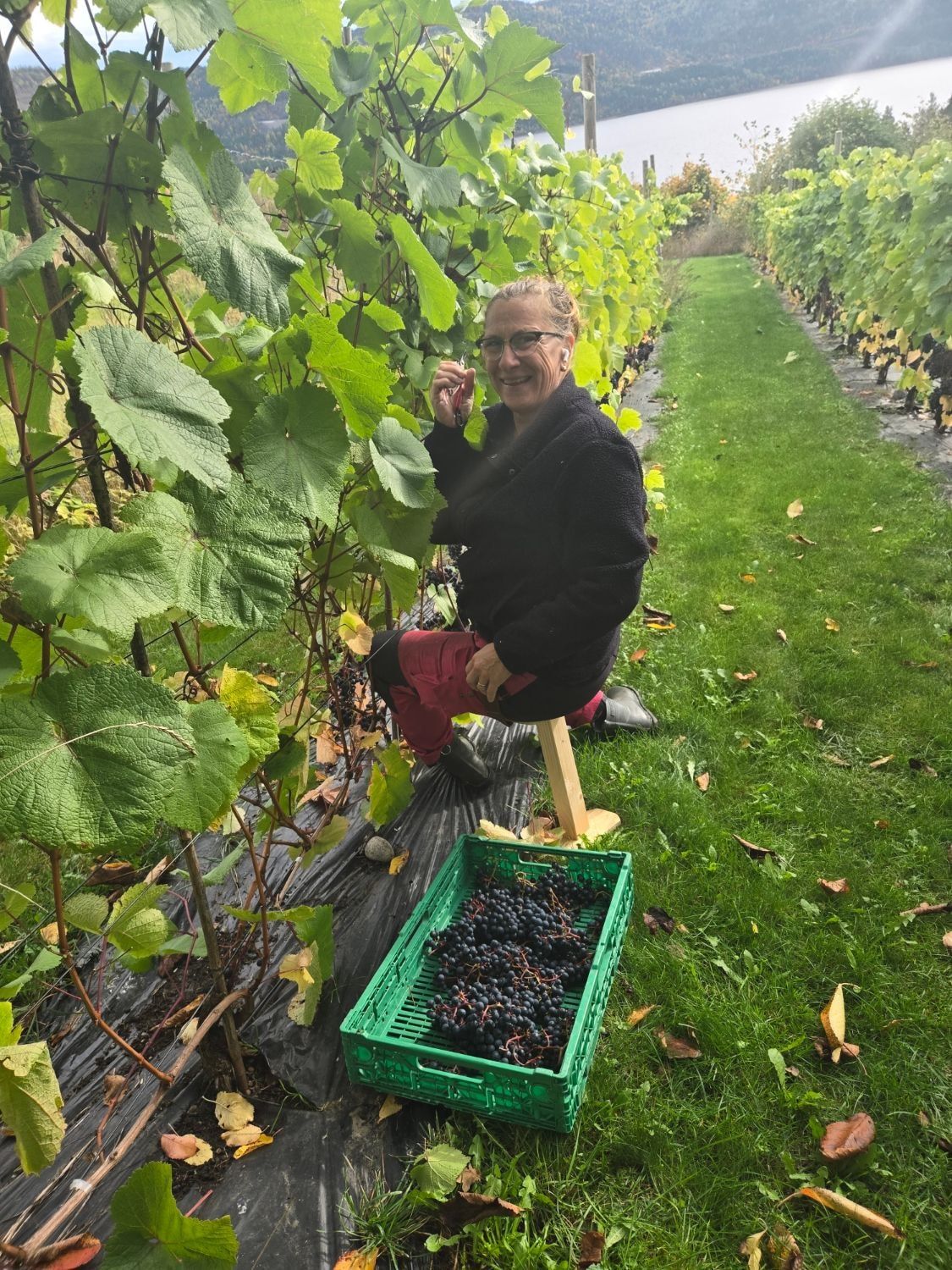
Harvest usually falls between the middle and the end of September.
2025
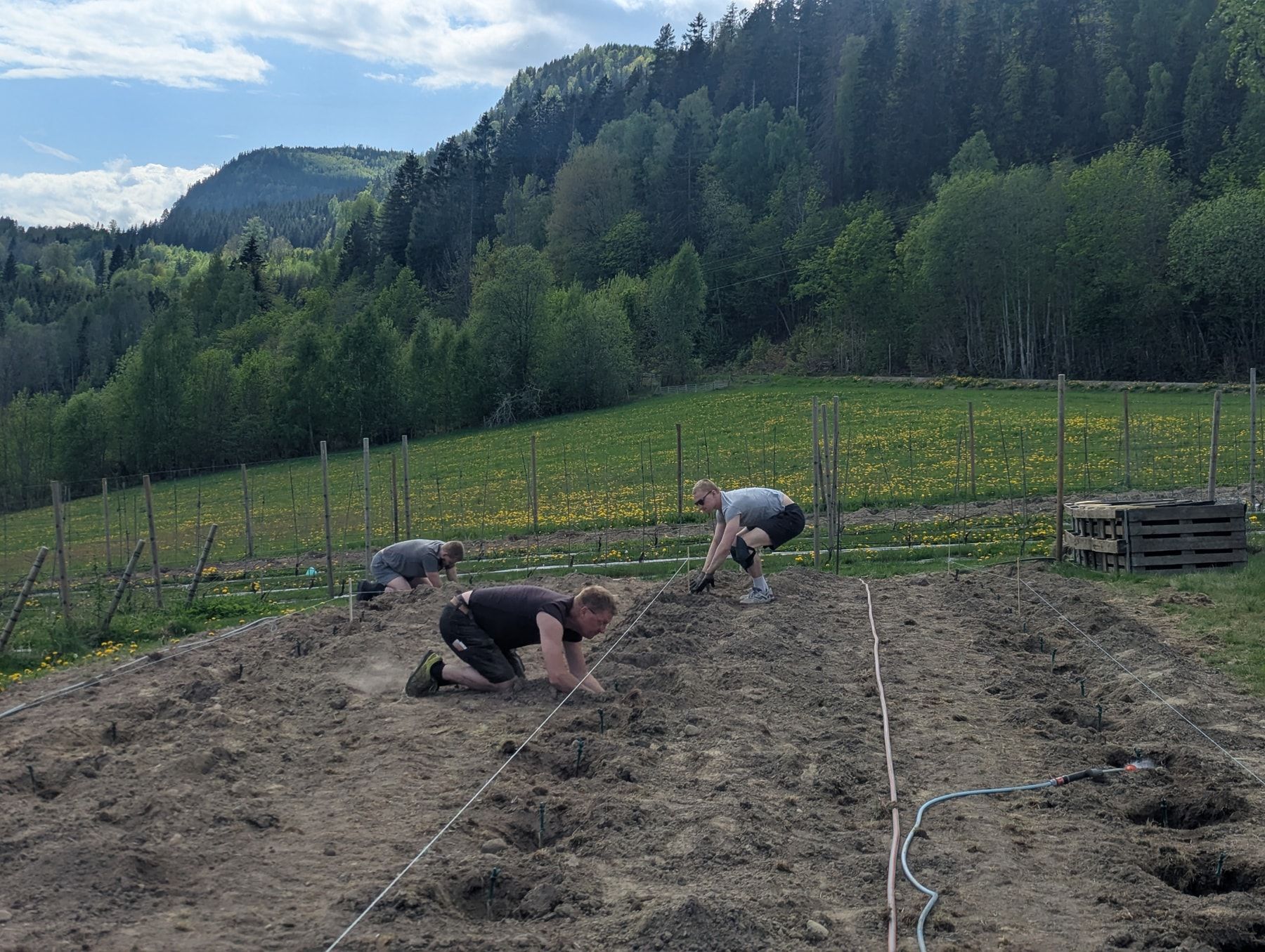
In 2025 the site was extended. The ground was broken, the rows were marked out with string, and the vines were set by hand. Frühburgunder and Muscaris brought two new varieties into the vineyard.
New vines take some years to bear. An extension is a decision about what the farm will look like some way into the future.
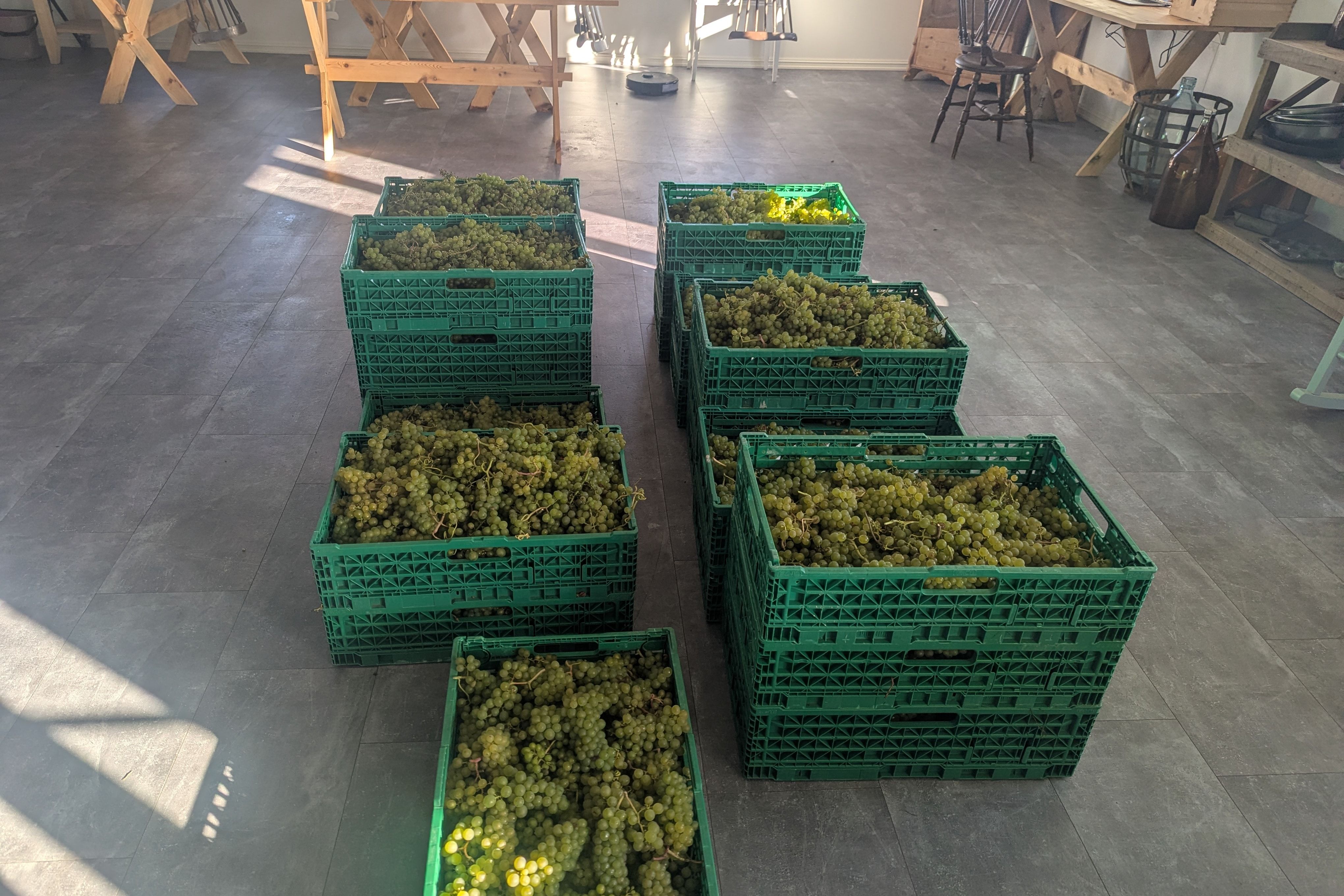
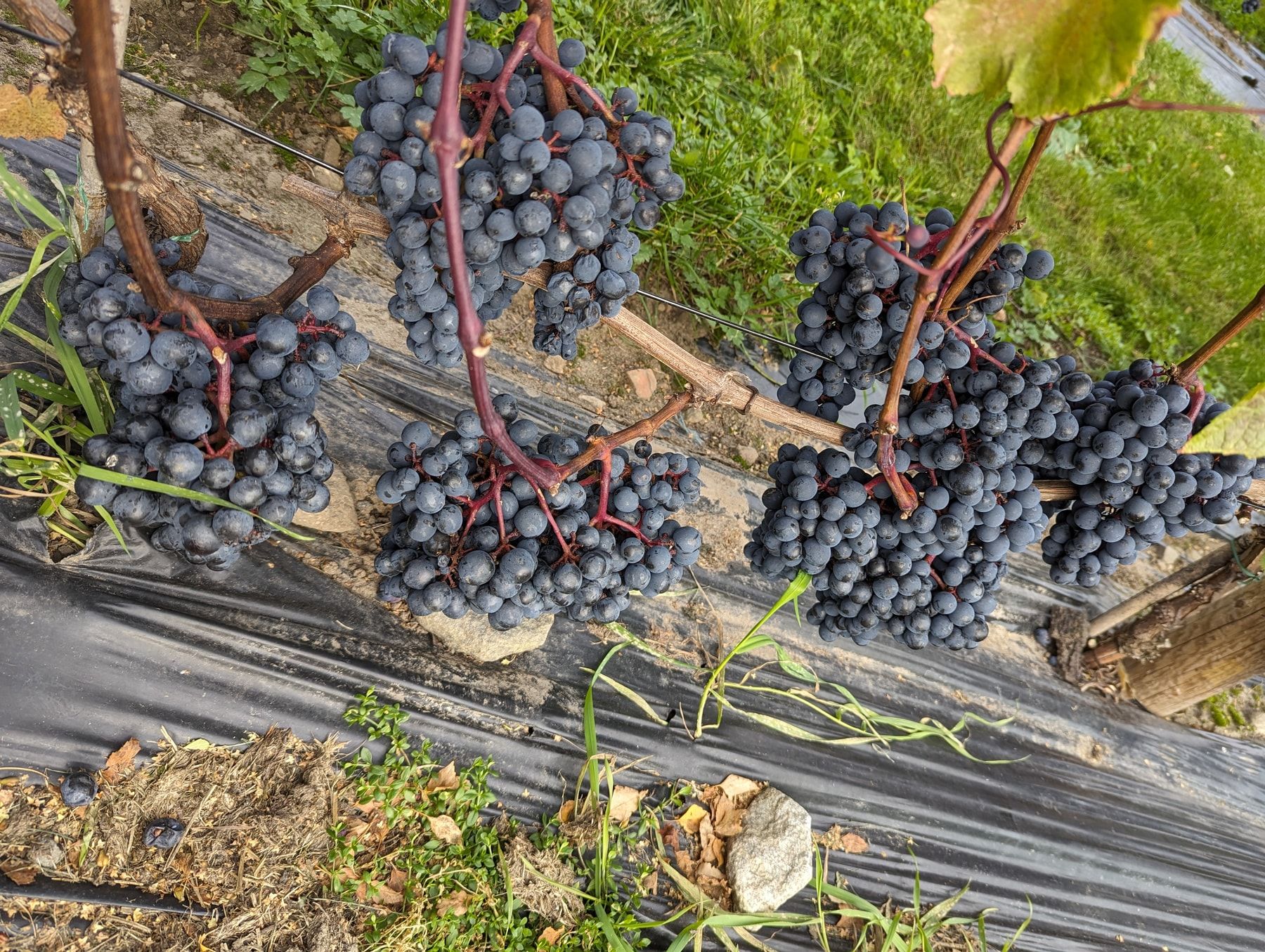
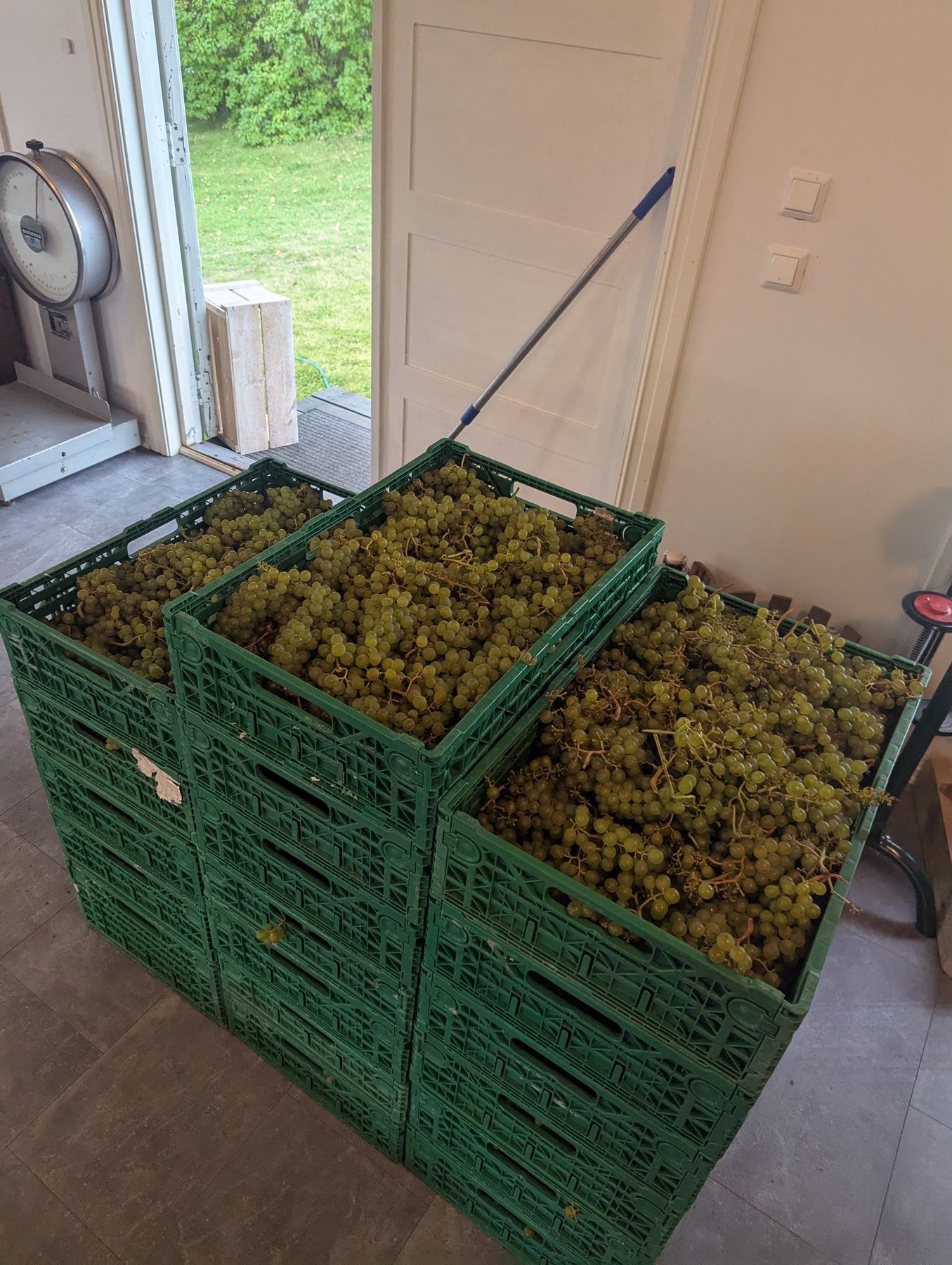
Freshly picked Solaris comes in.
Production
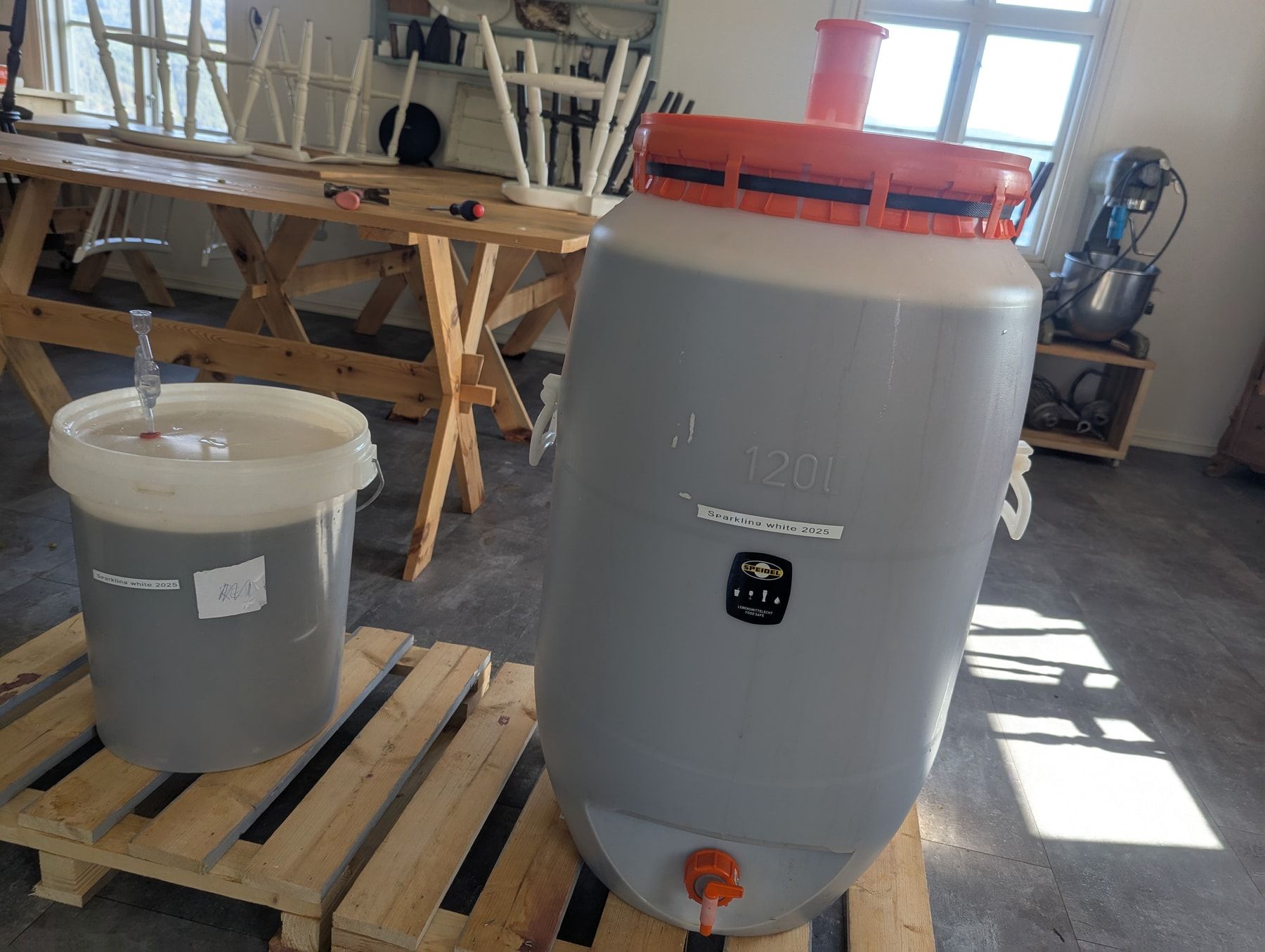
A room on the farm is fitted out for winemaking. Everything that happens after harvest happens here.
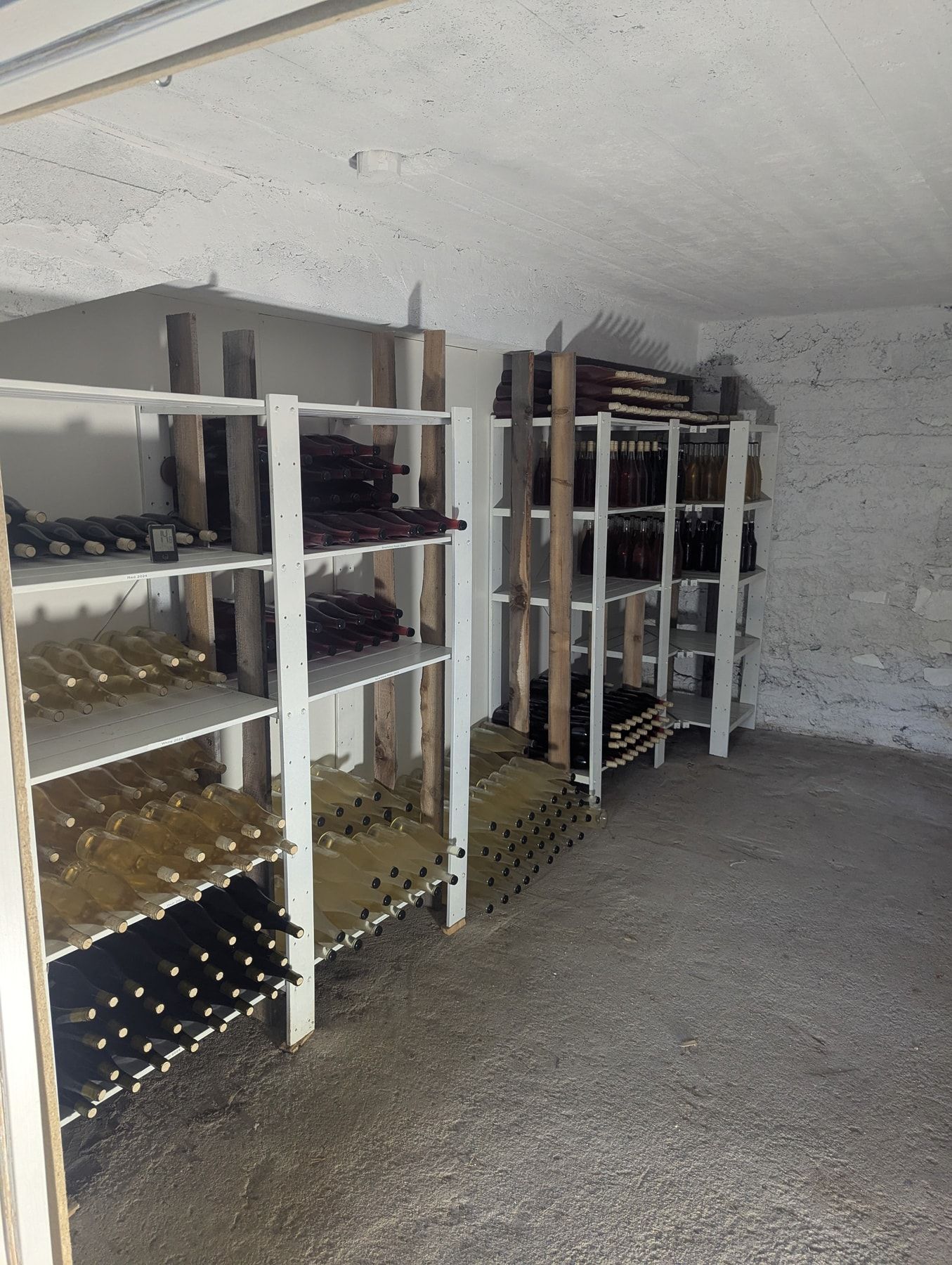
Producing alcoholic drink for sale in Norway requires documented production methods and premises fit for the purpose. The room has been fitted out to meet it, and finished wine is laid down to mature.
Receiving
The crates are carried in from the vineyard and weighed.
Destemming
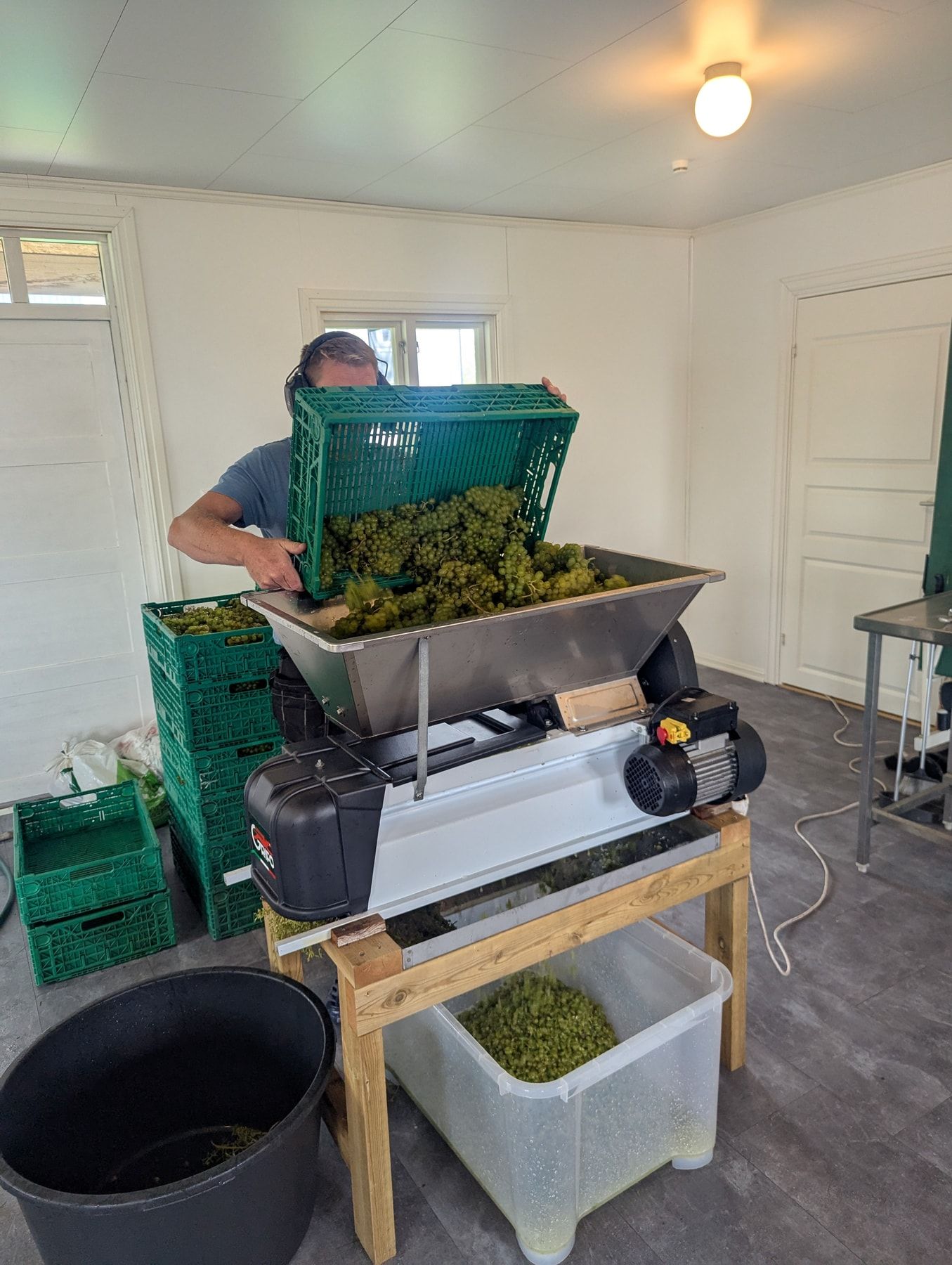
The stems are removed before pressing.
Pressing
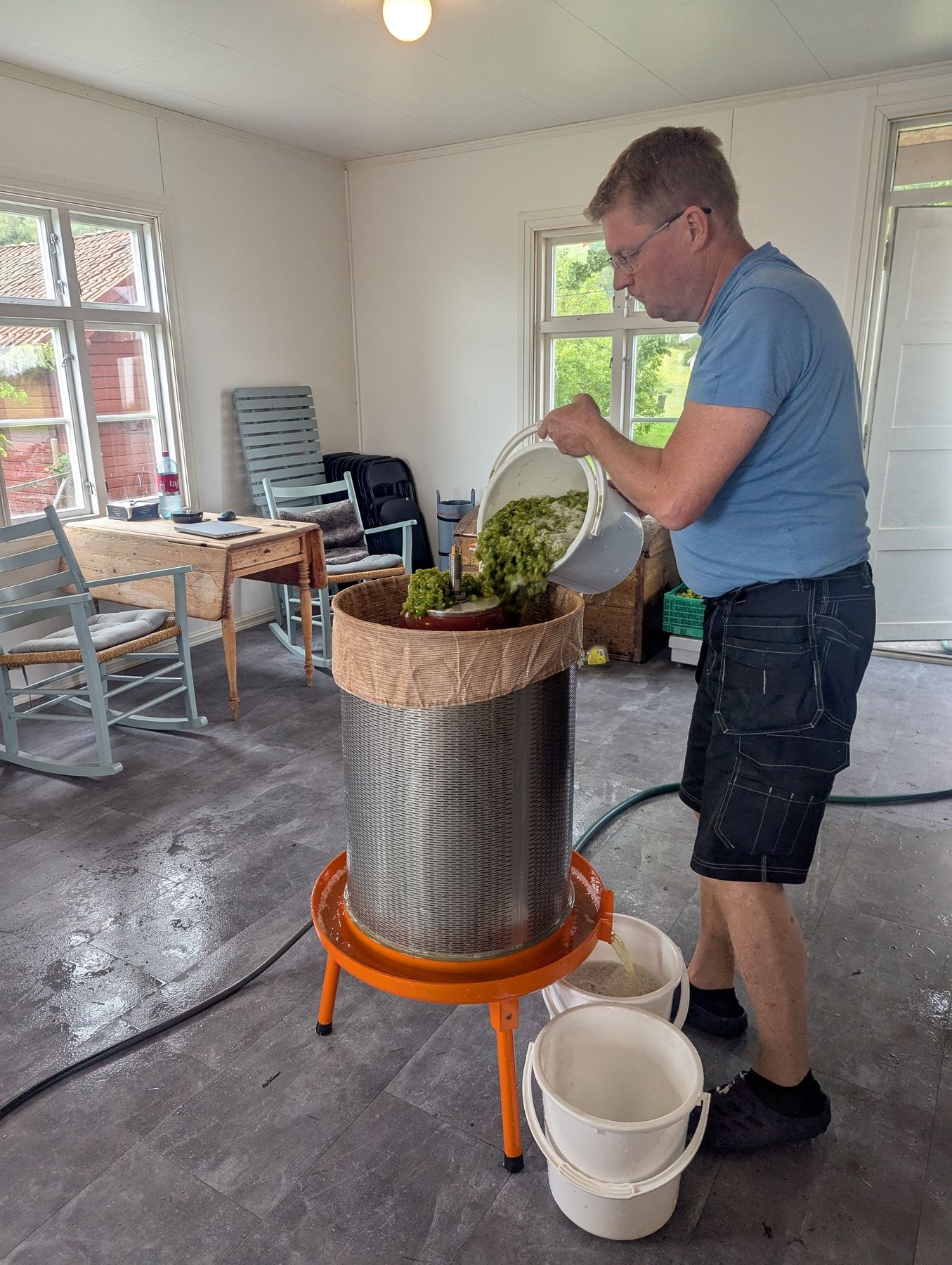
The grapes are pressed.
Fermentation
Fermentation is started. What follows depends on the style of wine and the kind of fermentation it calls for.
Maturing
Once those processes are complete, the wine is laid down to mature.
Bottling
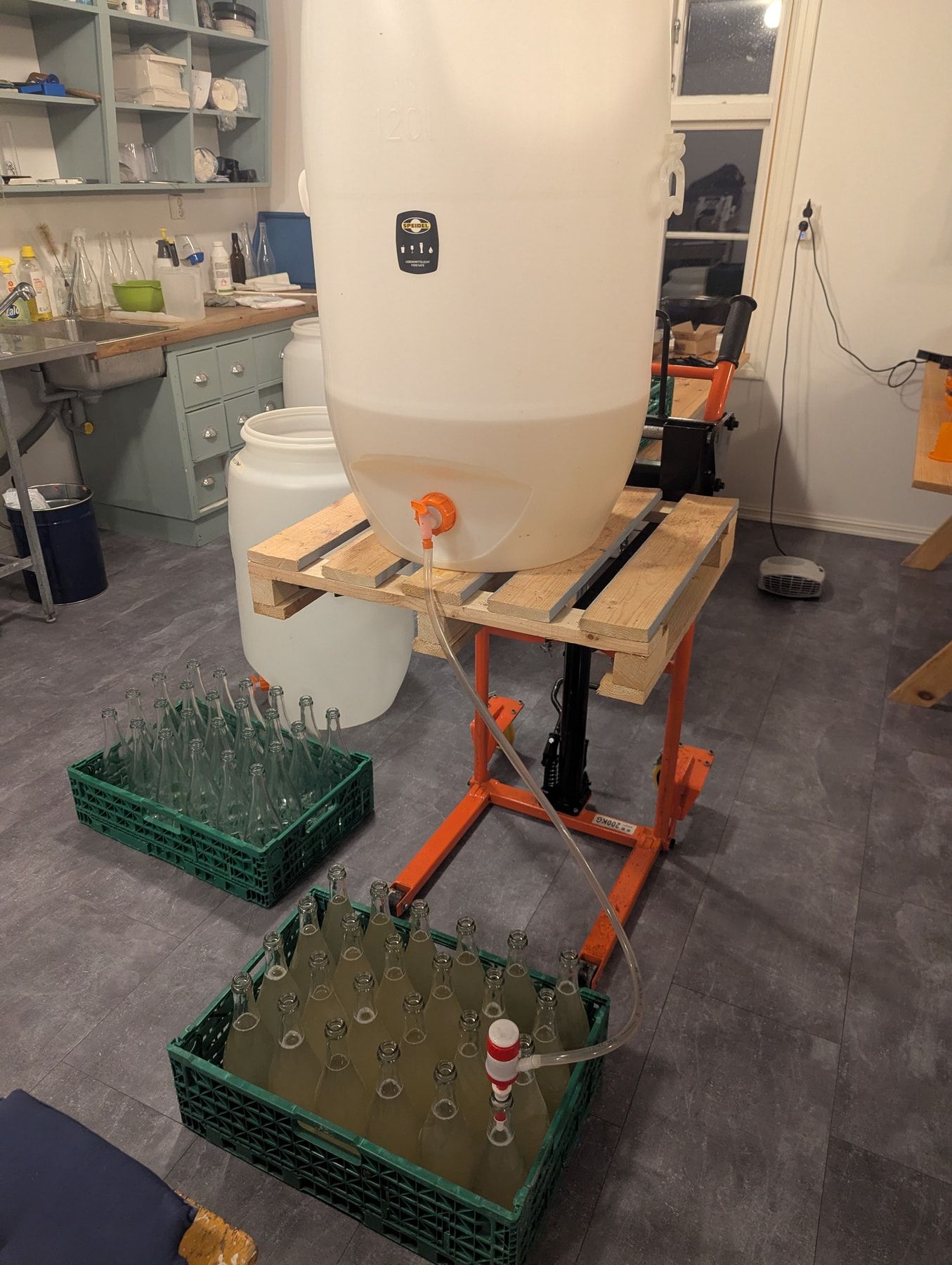
The wine is bottled and closed.
For sparkling wine
Second fermentation in bottle, kept under a crown cap.
After 1–3 years on the lees
Clarifying and disgorging — where the bottle gets a “champagne cork”.
‘To this day we have used no outside help, but have developed all of it ourselves, from nothing.’
André has the main responsibility for the winemaking. It demands precision, and there is a great deal to learn.
The equipment is plain: a destemmer, a water-bladder press and plastic fermentation vessels. The work is done by hand, by two people, in the weeks after harvest.
The Norwegian grape growers’ association
Getting through those requirements is a process with a steep learning curve. Advice from other growers in Foreningen Norske Druedyrkere, the Norwegian grape growers’ association, has helped.
The association has members growing on every scale across much of Norway. They meet regularly and exchange experience, and the association runs courses in both vineyard work and winemaking. It also holds an annual judged wine show. Nordre Drag has entered since 2023.
The wines
What the year in the vineyard and the weeks after harvest come to is listed on the wines page.